Mauser .25 pistol
The Seven Dials MysteryThe Mauser .25 pistol is the small, carefully handled weapon at the center of the reconstruction of Jimmy Thesiger’s staged attack. Its importance lies not only in the shot that wounded him, but in the physical traces left when it was thrown through a window and found on the lawn. Initially presented as evidence of a fleeing assailant, it ultimately helps Superintendent Battle expose the supposed attack as part of Thesiger’s deception.
Appearance and First Recovery
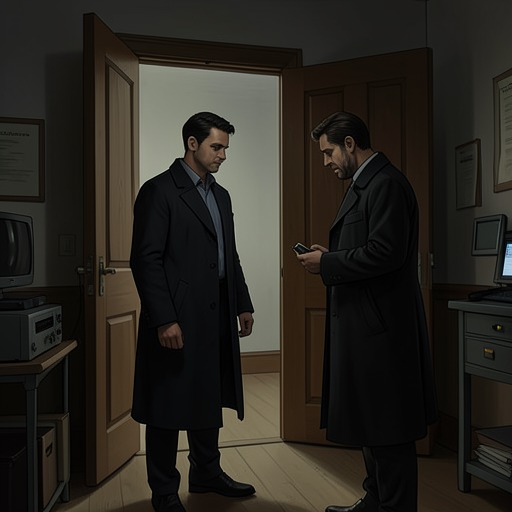
Sir Oswald Coote found the pistol on the lawn outside and brought it to the investigation, holding it delicately by the butt. He supposed that one of the thieves had dropped it while running away, and had preserved it carefully in case Battle wished to examine it for fingerprints. Battle accepted it with equal care and placed it on the table beside Jimmy Thesiger’s Colt. The two guns, set side by side, made the competing account of the shooting tangible: one was associated with the apparent exchange of fire, while the smaller Mauser would prove to have a different part in the scene.
The pistol’s position outdoors did not, by itself, establish who had put it there or why. Sir Oswald’s explanation gave it an apparently straightforward role as a discarded weapon, but Battle did not treat that explanation as proof. When Sir Oswald later asked whether the pistol bore fingerprints, Battle shook his head. The absence of that trace did not resolve its history; the weapon’s placement, the ground around it, and the bullet damage offered a more revealing set of clues.
The Lawn and the Reconstructed Throw
Battle challenged the idea that the pistol had simply been dropped in flight. He had reconstructed the scene from the marks on the lawn: one set of footprints crossed the relevant patch, and they belonged to Sir Oswald. Loraine Wade’s tracks also crossed the lawn, but farther to the left. A dent in the grass suggested that the pistol had struck the ground with force. Taken together, the marks indicated a throw rather than an accidental loss.
Sir Oswald proposed a possible alternative: a fleeing man could have used the path, left no footprints there, and hurled the pistol into the middle of the lawn. Battle’s reasoning did not depend on claiming that such a route was physically impossible. Instead, the pistol’s impact mark and the distribution of the footprints allowed him to test the weapon’s placement against the story told about it. The scene that first seemed to implicate an unknown thief could also be understood as a deliberate act of disposal.
That distinction became more significant when Battle later tested the throw himself. At first, he had only a faint suspicion. He arranged for Sir Oswald to throw the pistol through the window, then observed that it landed considerably farther away than it should have if thrown by a right-handed person using the left hand. The result helped him infer that the original throw had been made with the left hand. The pistol thus supplied a physical comparison between an account of the scene and the bodily action required to produce it.
The Wound and the Staged Attack
Battle’s final reconstruction connected the Mauser to the wound in Thesiger’s right arm. The two bullets on the table distinguished the weapons’ roles: the larger .455 bullet had been fired from Thesiger’s Colt, grazed the window sash, and lodged in the trunk of a cedar tree; the smaller bullet came from the Mauser. It passed through the fleshy part of Thesiger’s arm and embedded itself in an armchair. The injury was real, but Battle’s explanation made clear that it did not establish the presence of an attacker.
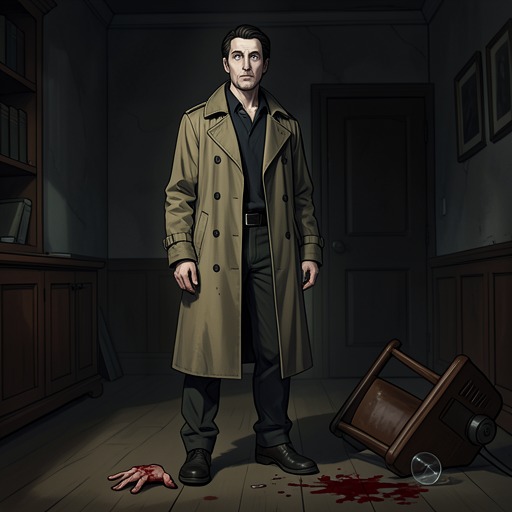
In the staged version of events, Thesiger used his left, gloved hand to take the Mauser from his pocket and shoot himself through the fleshy part of his right arm. He then threw the pistol through the window, pulled off the glove with his teeth, and cast it into the fire. The Colt’s shots supplied the appearance of a gunfight; the Mauser supplied a genuine wound that could make that appearance convincing. Together, the weapons and the injured arm supported a scene that Battle initially accepted, even though the bullets’ separate paths eventually helped him understand how it had been arranged.
Forensic and Narrative Significance
The pistol’s meaning changes as the investigation moves from the apparent crime scene to Battle’s later explanation. On its first appearance, its presence outdoors seems to support Sir Oswald’s theory that a thief discarded it while escaping. The footprints, dent, bullet trajectory, and experiment with the throw progressively unsettle that reading. No single clue carries the whole conclusion: the force of the impact suggests a throw, while the greater-than-expected distance in Battle’s test points toward the use of the left hand. Their value comes from how they test the story against the material scene.
Battle did not claim to have understood the ruse immediately. He says that he was taken in at the time and that finding the burnt glove began his later reconstruction. The test with the pistol strengthened a suspicion, but he describes that suspicion as faint. This qualification matters: the weapon does not function as an instant, self-explanatory solution. Its evidence acquires force through comparison—with the Colt, the bullets, the tracks, the wound, and the manner of the throw—until a discarded-looking object becomes evidence of the attack’s staging.
In the account of the crime, the Mauser is therefore both weapon and prop. It inflicts the wound that makes Thesiger’s story plausible, then appears to confirm that story by lying outside the window. Yet the very act meant to make it look like a fleeing assailant’s discarded gun leaves a trajectory that can be reconstructed. The pistol’s double role gives Battle a route from the visible evidence of an attack to the concealed actions that produced it.